Functional precision psychiatry: iPSC-derived neurons as predictive assays for antidepressant response
Antidepressant treatment selection remains largely empirical, with many patients cycling through multiple therapies before achieving response. Pharmacogenomic (PGx) approaches have narrowed uncertainty at the level of drug metabolism, yet their ability to predict clinical efficacy has remained modest, constrained by reliance on static genetic proxies rather than functional neurobiology. This persistent gap highlights a broader challenge in psychiatry: the challenge in finding biologically grounded tools that can prospectively guide therapeutic choice.

Antidepressant treatment selection remains largely empirical, with many patients cycling through multiple therapies before achieving response. Pharmacogenomic (PGx) approaches have narrowed uncertainty at the level of drug metabolism, yet their ability to predict clinical efficacy has remained modest, constrained by reliance on static genetic proxies rather than functional neurobiology. This persistent gap highlights a broader challenge in psychiatry: the challenge in finding biologically grounded tools that can prospectively guide therapeutic choice.
A methodologically distinct approach is now generating translational evidence. Induced pluripotent stem cell (iPSC)-derived neuronal models enable the generation of patient-specific neurons, allowing direct pharmacological interrogation in a disease-relevant cellular context [1, 2]. These systems recapitulate key aspects of neuronal function, including synaptic activity, network connectivity, and stress-response signaling. Critically, patient-derived neurons can stratify antidepressant responders from non-responders at a functional level - capturing differences in synaptic connectivity, dendritic morphology, and gene expression that associative biomarkers cannot resolve [3,4,5,6].
This distinction, from associative to mechanistic, is essential. Where PGx asks “how will this patient metabolize the drug,” iPSC-based assays ask “how will this patient’s neurons respond to it,” fundamentally different biological questions. Emerging data suggest that functional cellular responses may more closely mirror clinical outcomes, particularly in disorders where treatment response is driven by complex, polygenic pathways [3, 4]. As such, iPSC-derived models offer a path toward directly observing drug effects in the relevant biological substrate, rather than inferring them indirectly (Fig. 1).
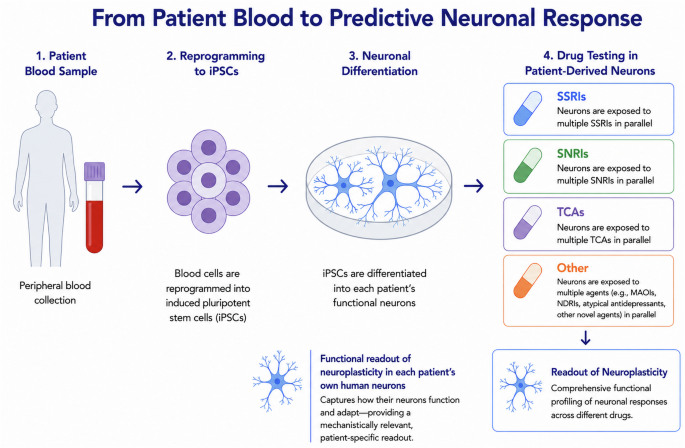
Peripheral blood cells are reprogrammed into induced pluripotent stem cells (iPSCs) and differentiated into patient-derived functional neurons. These neurons are exposed in parallel to multiple antidepressants across drug classes. Drug-induced changes in neuroplasticity are quantified to generate a functional, patient-specific ranking of neuronal response, providing a biologically relevant readout to inform antidepressant selection.
The relevance of this approach might also have relevance in late-life psychiatry. Aging introduces mitochondrial dysfunction, neuroinflammatory processes, and declining neuroplasticity, all of which contribute to marked heterogeneity in treatment response. Genetic panels are structurally limited in their ability to capture these complex influences. In contrast, iPSC-derived neurons provide a patient-specific platform through which therapeutic sensitivity can be assessed. While direct reprogramming approaches would be particularly advantageous in this setting because they preserve age-associated epigenetic features more faithfully, the only currently available commercially scalable, rapid, and cost-effective platform for neuronal generation and functional readout relies on hiPSC-derived neurons, despite their partial loss of age-related epigenetic signatures during reprogramming [3, 5, 6].
Recent technological advances have accelerated the translational potential of these platforms. Improvements in reprogramming efficiency, standardized differentiation protocols, high-content imaging, and automated analysis pipelines have enhanced throughput, reproducibility, and availability while reducing the costs and turnaround time [2, 5, 6]. These developments enable a transition from small-scale experimental systems to scalable assays capable of generating clinically actionable data. Early implementations are already demonstrating first-prescription accuracy that meaningfully exceeds current standard-of-care benchmarks, suggesting that functional cellular assays may outperform existing biomarker strategies in guiding treatment selection [3, 5, 6].
As neuropsychopharmacology moves toward biologically informed clinical staging and precision intervention, iPSC-derived neuronal assays represent a practical inflection point. They are among the first tools capable of integrating genetic and functional dimensions of patient biology into a single predictive framework. In doing so, they offer a pathway to reduce trial-and-error prescribing and improve outcomes in a field that has historically lacked prospective, mechanism-based decision support.
Schedule a Meet & Greet
Contact Us
78 John Miller Way,
Kearny, NJ 07032, USA
Yigal Alon Street 126
Tel Aviv-Yafo, Israel